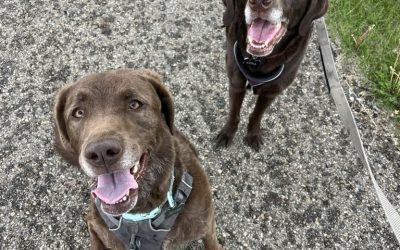
“Is there any hope me and my pup can have a peaceful walk? Did we wait too long?”
It’s something we hear from dog owners all the time.
Maybe your dog has been barking and lunging at other dogs for years. Maybe walks have gradually become more stressful as your dog has developed stronger reactions to people, bikes, squirrels, or other triggers. Or perhaps you’ve had a life change that requires more exposure to distractions and have simply reached the point where you’re wondering:
Is it too late to train my reactive dog?
The good news? No, it’s not too late.
Dogs can learn at any age, and with the right approach, even long-standing reactive behaviours can improve. That said, there is an important but:
The sooner you start, the sooner you can start seeing progress—and the easier the process may be.
Why Does Reactivity Get Harder Over Time?
Reactivity is not simply your dog being “bad” or stubborn. When a dog reacts by barking, lunging, growling, pulling, or trying to get away, they are having big feelings and communicating that something about the situation is difficult for them.
That reaction could be driven by fear, frustration, excitement, anxiety, or a combination of factors.
Every time your dog encounters a trigger and has a big reaction, they are practising that behaviour. And just like any behaviour, the more it rehearsed, the higher the likelihood that it will happen again.
This is one reason starting sooner can make a difference.
If your dog has only recently started reacting to other dogs, for example, there may be an opportunity to address the behaviour before it becomes a well-established pattern.
But what if your dog has been reactive for years?
You can still make progress.
It may take more time, patience, and careful management, but an older reactive dog is absolutely capable of learning new skills.
Dogs Don’t Have an Expiry Date on Learning
One of the biggest misconceptions we hear is that an older dog is somehow “set in their ways.”
While age and experience can influence how quickly a dog learns, they don’t mean that learning stops.
Dogs continue to learn throughout their lives.
In fact, training an adult or senior dog can be incredibly rewarding because you’re not starting from scratch. Your dog already has a personality, a history, and plenty of things they know how to do. Our job is to build on that existing foundation and help them develop better ways of responding to situations they find challenging.
At Dog Jogs, we believe training should be about more than simply stopping a behaviour.
We want to help you understand why your dog is reacting in the first place.
Once we understand the “why,” we can start working on the “what do we do instead?”
Why Force-Free Training Matters for Reactive Dogs
When your dog is already struggling with a trigger, adding fear, pain, or intimidation to the situation isn’t the approach we want to take.
Dog Jogs uses force-free, positive reinforcement-based training. That means we focus on setting dogs up for success, rewarding/ reinforcing desirable behaviours, and helping them feel safe and confident while they learn.
For a reactive dog, this might involve gradually introducing them to a trigger at a distance where they can remain comfortable, while creating positive associations with that trigger.
This process can include techniques such as desensitization and counterconditioning, alongside teaching your dog alternative behaviours and giving them the skills to cope with challenging situations.
The goal isn’t simply:
“Make my dog stop barking.”
Instead, we’re asking:
“What do you want your dog to do in these situations, and how do we teach your pup that in a way that builds their confidence, helps them stay calm, and sets everyone up for success ?”
That difference matters.
The Sooner You Start, the Better
If your dog has started showing signs of reactivity, you don’t have to wait until things become unmanageable before asking for help.
In fact, getting support early can be one of the best things you can do.
Early training can help you:
- Recognize your dog’s triggers and body language
- Learn to spot the signs that a reaction is building
- Prevent your dog from repeatedly rehearsing reactive behaviours
- Create more successful walks and outings
- Build your dog’s confidence
- Learn how to respond calmly and consistently
- Develop a plan that works for your individual dog and fur-family
And perhaps most importantly, early intervention can help prevent you from feeling like you have to avoid the world just to keep your dog calm.
Because we know that living with a reactive dog can be stressful for the humans, too.
But What If We’ve Already Been Struggling for Years?
Start now.
Seriously.
Don’t let the fact that you didn’t start six months ago—or six years ago—stop you from starting today.
You might need to adjust your expectations. Behaviour change isn’t usually an overnight transformation, and every dog progresses at their own pace.
Some dogs may begin showing small changes relatively quickly. Others need more time to build confidence and learn new skills.
Progress might look like your dog noticing another dog across the street and choosing to look back at you instead of immediately barking.
It might be being able to walk past a trigger at a greater distance.
It might be recovering from a reaction more quickly.
And sometimes, progress is simply having a walk where everyone makes it home feeling a little less stressed than they did last time.
Those wins matter.
Reactive Dogs Don’t Need to Be “Fixed”
We also want to change the way we think about reactive dogs.
Your dog isn’t broken.They aren’t a bad dog.
And you haven’t failed as a dog owner because your walks aren’t looking the way you imagined they would.
Reactivity is a behaviour, and behaviour can change.
Our role as trainers is to help you understand your dog’s communication, identify what they need, and give both of you the tools to navigate the world more comfortably.
At Dog Jogs, we work with reactive dogs in Edmonton, Sherwood Park, St. Albert and Ardrossan using individualized, force-free training plans. Our goal is to help dogs and their people build confidence, improve communication, and enjoy more successful everyday experiences together.
So, Is It Too Late to Train a Reactive Dog?
No.
Whether your dog is a young pup who has just started reacting or a senior dog who has struggled with reactivity for years, it is never too late to begin working toward positive change.
But if you have been wondering whether you should start training, our answer is simple:
Don’t wait for the behaviour to get worse before you ask for help.
The sooner you start, the sooner you can begin learning what your dog is communicating, preventing unnecessary reactions, and building new skills.
And if you’ve been putting it off because you think your dog’s reactivity is “too far gone,” take a breath.
Your dog can still learn.
And you don’t have to figure it all out on your own.
Ready to make walks a little calmer?
Dog Jogs offers force-free dog training for reactive dogs in Edmonton, St. Albert, Sherwood Park, and Ardrossan. Our personalized approach focuses on helping you understand your dog’s behaviour and giving you practical tools you can continue using long after your training sessions are finished.
Check out our Reactivity Training Packages here
Let’s get those walks running smoothly again.